Saturday, May 30, 2009

".....пять, четыре, три, два, одно, воспламенения"


The heading translates as the last six seconds in the countdown for a rocket launch from Baikonur Cosmodrome, USSR.
What on earth (or in space) does that have to do with anything? I hear you ask.

Well, I was a child of the space-age.
When the USSR launched Sputnik in 1957, I was just on 11 years old and from that moment I followed the space-race so keenly that I would lay awake at night in my boarding-school bed listening (on a small transistor radio with ear-piece) to The Voice Of America short-wave broadcasts of every US space launch.
The Russians weren't as forth-coming; they would only publicly announce after the event (and then only if it was successful) but the excitement I felt wasn't any less.

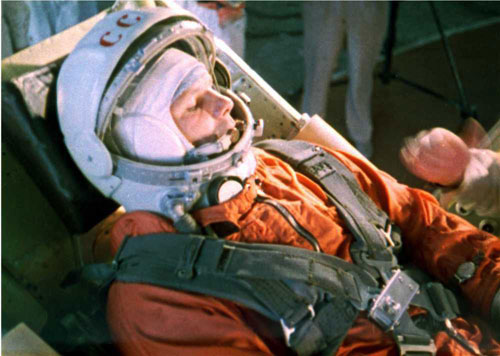
On 12th. April 1961 the first man went into space: Yuri Gagarin orbited the earth.
This was science-fiction come to life and it didn't matter that the hero was Russian - it was the event itself that was awesome.

Anyway - getting to the point - I recently discovered that the type of watch that Gagarin wore into space was available on the internet and, after doing some research, I happened upon the example shown here.
The watch-band and the dial are reproductions - modern replacements for what must have been very tired 50-year old originals - and the original perspex crystal has been replaced with a more recent (acrylic) item, but the movement, case and back-plate are exactly as issued back in the 1960's.

It was a hand-wound Shturmanskie (often spelt without the 'h') with central seconds complication and a hacking feature that allowed the watch to be precisely stopped and synchronised with a given time signal.

The Shturmanskie that Gagarin wore into space had a highly finished (including Geneva striping) 17 jewel, shock protected movement. The movement was housed in a chrome plated, two-piece case measuring 33 mm across, 12 mm high, with a 16 mm lug size and had a stainless steel screw back.

A little item of nostalgia with which to commemorate the 48th. anniversary of the event and something which I will enjoy wearing occasionally.

Friday, May 29, 2009

Orient - Not widely known.


This is a brand-name that you will not find in many (if any) "watch shops" in Australia.
In amongst the vast numbers of Seiko, Citizen and Casio watches from Japan you will be hard-pressed to detect an Orient.
Yet the brand is as old as (if not older than) Seiko and although Seiko now own Orient the watches continue to be produced independently, with Orient making their own movements - and they have a high reputation for the excellence of their automatic mechanisms.

My father owned an Orient back in the late 1950's - I can still see the distinctive logo, with the two lions holding the shield with the 'O' in the centre - to my eyes a very "British" logo and not at all oriental.

It was only recently, and quite by chance, that I discovered that these watches still existed and after spending some time deliberating I finally decided on the model shown here - a satin-black (ion plated, or "IP") stainless-steel Orient Star with the distinctive power-meter on the dial at one o'clock and the display of the date at nine o'clock. The crown is at four o'clock.


This is an impressive piece of time-keeping equipment; whilst not as large as the current crop of "diver" models out there (the diameter of the crystal is approx. 33mm) it is a solid and "chunky" unit and, with the black finish, looks bigger than it really is. It is also reasonably heavy, as the stainless-steel bracelet is comprised of solid links.


I'm in two minds about the usefulness of power meters on automatic watches, seeing no real advantage in having any indication of the time remaining before the watch needs to be shaken again.
After all, those who wear one watch - and that would be the vast majority - only take it off at night and as a modern automatic movement can run for more than 30 hours before needing another shake, the owner isn't likely to need an indication of what power remains.
Even 1950's-vintage manual-wound watches are capable of running for 30 hours between wind-ups, so what's the point?
On this style of watch-face the power indication doesn't clutter the dial but on a chronograph with multiple complications, the dial can look a bit overcrowded.

I like this watch and I particularly like the black IP finish. It has a definite presence but in an understated, almost stealthy, manner. Certainly the opposite to Seiko's Advans, Vanacs and their cousins from the 1970's!

Wednesday, May 27, 2009

Let's not forget the LCD's!


Remember when the magic of digital watches arrived?
Firstly it was the glowing red LED's of such things as the Pulsar range (now very collectible) and then the world was taken by storm with companies such as Casio, Citizen and Seiko producing a vast range of LCD watches - such as the two seen here.

The first watch featured is an example of Seiko's A639 module, from 1981.
This model included regular time-keeping, in 12 or 24-hour mode; day & date; an hourly chime; an alarm and a stop-watch. It also boasted a light - operated by the bottom-right button.


This watch - like most LCD Seiko models - came with a stainless-steel case and bracelet, as pictured here.
The clasp is signed and includes Seiko's "SQ" logo to indicate quartz timing.

12-HOUR or 24-HOUR SETTINGS:
For those of you who have this watch but not the user's manual or guide to the settings, one of the most confusing is how to switch between 12-hour and 24-hour display. Each of the others are pretty straight-forward, but this one had me beat for a while.

This is the sequence:
Go to Time Setting mode, then sequence through seconds, then minutes, then tens of minutes, then hour and when in the hour-setting mode (the hour digit is flashing) press the bottom right-hand button.
Voila! You can switch between 12 or 24-hour display.
_______________________


SOLD (July 2010)

One of my favourite LCD watches is this Citizen digital-analogue (Digi-Ana) hybrid from October 1979.
This watch features dual-time capability - one display in analogue and the other in digital. Two time-zones can be monitored if desired.
In addition there is an hourly chime; an alarm feature; day & date and also a stopwatch.

I was fortunate when buying this watch in that it includes the original Citizen (signed) leather watch-band; a nice change from the regular stainless-steel bracelets.

Both of the watches operate perfectly.
I had to clean around the press-buttons of the Citizen, removing a couple of decades of gunk.
Once this was accomplished, all functions resumed normal service - just as they had done some 20 years previously, when the watch was shipped from the Citizen factory.


A nice detour from the analogues and these are two watches which I wear occasionally but mainly use to keep a pretty accurate check on the time-keeping qualities of some of my non-quartz models.

Everyone should own at least one period Seiko, Casio or Citizen LCD.....just for old-times sake!

Monday, May 25, 2009

Citzen's 8110A chrono - in Green & Burnt Orange!


With a face like that it has to be from the 1970's........and, of course, it is. October 1974, to be precise.
As with most of my previous acquisitions I was attracted by the design and colours - the hexagonal sub-dials with their graduated colouring from yellow to orange; the emerald-green dial; the octagonal case. All worked for me, baby!


However, upon arrival of the watch I noticed that the dial was more blemished than I was led to believe and that the 12-hour hand (sub-dial at 12) was inoperative.
Other than those glitches, the watch operated correctly, keeping good time, and was all-original, including the signed stainless-steel bracelet.

Apparently the Citizen 8110 movement is considered to be somewhat ordinary by those who know watches (and I'm not one of them and don't pretend to be), and can be a pain in the posterior to work with.
However, a local watchmaker, whose expertise I have used in recent months, is taking a look at this blast-from-the-past in order to bring the non-functional sub-dial back to life, although the blemished main dial will have to stay that way.

But irrespective of the few scratches and aging, nothing can take away the nostalgic charm of this 1970's design.
It evokes mini skirts, flares, cassette tapes and ABBA! Groovy!

Sunday, May 24, 2009

A Trio of Accutrons


The Bulova Accutron "Tuning Fork" watch (thus the logo seen on the dials of the watches shown below) was developed in the early 1960's and had, like its electronic competitors from Seiko, Citizen and others, been surpassed by quartz technology by the end of the 1970's.

Bulova watches were extremely popular in the United States, being worn by corporate executives, movie stars, politicians and many high-profile celebrities. They were also that country's most popular "30-year" watch, thousands being presented to those entering retirement after a lifetime of company service.

The Accutrons shown here cover the period in which they were produced, with the oldest being manufactured in 1965, the second in 1970 and the youngest in 1976.

This model, from 1976, has a stainless-steel case and backplate, with a silvery dial, indices and hands.
It sports the original Bulova sharkskin watchband complete with signed buckle.
The watch is in excellent shape and keeps accurate time.

Like all "tuning-fork" electronic movements, it has a high-pitched hum, which can be clearly heard when held to the ear and is unlike the sound made by any other type of electronic movement.


SOLD April 2015
This beautiful gold (10k gold-filled) Accutron was manufactured in 1970 and is in superb original condition. It is set off by the integral mesh bracelet, complete with original signed clasp.
The creamy textured dial is unmarked and the hands and indices are perfect.
A beautiful watch in anybody's language.

Finally, from 1965 comes another gold-filled (14k) item, this one being a 30-year presentation gift to a gentleman who retired from "C&M" in 1969 after many years of loyal and faithful service.

Once again, it is in original configuration, with the exception of the after-market lizard-skin watchband. The case, dial, hands and indices are all in wonderful condition after more than 40 years and the watch hums along beautifully.

I really like the Accutron models, not just for their interesting technology but also because they were a stylish watch, a very elegant accessory.
Even today they do not look out of place peeking out from under the cuff of a business shirt.

The Jewel in the Crown - Vanac KS

SOLD March 2015

From November 1973 comes another fine example of Seiko's 1970's styling - the Vanac KS (King Seiko), with their high-beat 25-jewel cal. 5256 movement with day & date, 9-facet crystal, chunky indices and colourful dial - in this example an ocean-blue.


Even the case is sculptured, with bevelled edges, and the crown is signed (KS).
The leather strap is not original - I believe that these watches were issued with stainless-steel bracelets. Trying to find an original item may well be an impossible quest.


A fabulous design and probably the most highly-valued watch in my collection of Seiko's.

UPDATE :
I was so taken by this watch that a month later another one became available - a very similar dial, same design for the case but with the 5246 movement. In excellent condition.
It was such a nice item that I couldn't resist! Now they share the same box, like peas in a pod. :)

Friday, May 22, 2009

It MUST be the 1970's!


SOLD NOVEMBER 2015
This is an example of Seiko's Advan range.
Most, if not all, of these watches had colourful dials, "chunky" hour indices and sculptured hour & minute hands.
They were certainly from the 1970's - without even checking the back-plate for the manufacturing date it was easy to tell that they were seventies designs: the delicate faces of the 60's had gone and the quartz movements of the 80's had yet to appear.

This example - another Ebay purchase - has a bright and bold purple face, with hardly a blemish other than a small scratch on the illumination material of the hour hand.
The dial itself is in superb condition, with the stainless-steel indices and Seiko name quite shiny and the Advan sun logo & script in perfect order.

There is a day & date complication, with Kanji and English versions of the day display.

The watch uses Seiko's cal. 7039 movement and keeps very good time.
Overall size is approximately 37mm diameter and 41mm lug-to-lug.


The original bracelet is in stainless-steel and follows a similar pattern to that fitted to my Elnix (see below) with the toothed links.
The clasp is signed "Seiko" and "Advan".

A nice watch and one that always draws attention due to its colour.
You've gotta love the 70's!