Tuesday, July 14, 2009

A lovely old Orient - circa early 1960's


This charming period-piece hails from the 1960's but I cannot determine the exact year of manufacture as the watch is bare of any such information. The case-back simply displays "ORIENT" and the serial number; and Orient serial numbers have no connections (apparently) to year or month, as do Seiko watches.
The dial says "ORIENT" and then the name of the model, being "Fineness", under which is "17 Jewels".

Dial is unmarked, being finished in what appears to be a very fine creamy-gold textile pattern when viewed under magnification and when matched to the slim gold hour indices and slim black hour and minute hands, it presents a beautiful face, very delicate and extremely stylish.

Like most watches of the 1960's this old girl is small by comparison with the humongous devices marketed today and the dial is a mere 31.0 mm across, with the slim gold rim adding only 3.0 mm to the width. The projecting crown is 1.5 mm in section.
Thickness of the watch, from top of crystal to back of case, is a thin 7.5 mm.

When I received the Fineness (early May this year) I gave it 25 winds and it ran for 40 hours, keeping perfect time for that duration, the ticking of the movement clearly audible when held to the ear, unlike many automatic watches made today.
The movement is in beautiful condition, with no signs of corrosion or other deterioration and it beats away at about 180 bpm, perfectly happy with its lot in life.


The case is gold-filled, with a stainless-steel snap-on back and it sports a slim, supple black leather watch-band with gold buckle, matching the style and period just nicely.

A really lovely watch which gets its share of wear on those occasions when a coat and tie is called for.

Thursday, July 9, 2009

Old Gold restoration.........update.


Within the past week I have enquired about three types of refinishing for the watch case and bracelet:-
  • Gold plating (as per the original finish)
  • PVD
  • Powder coating
I also considered anodising but quickly learned through a bit of preliminary research that brass (the watch case) cannot be anodised.
The PVD route is not possible either - not because the application can't be done to what I have but because the cost for a "one-off" is too high and also because there is no-one here in my area who can do it.


So I thought about a powder coating as an alternative to anodising and PVD.

It's practical, it can be done locally, it is reasonably inexpensive and the choice of colours is broad.
But.....I would have to disassemble the bracelet completely - break it down to it's individual components so as to avoid any likelihood of having the coating affect the flexibility of the bracelet.

The decision, therefore, is to go to gold-plating and to reproduce the original coating, albeit this time in 24- carat. (That is the only plating they do......24 carat. The original is 9ct).

Cost to undertake this is AUS$120.


The only thing I need do is remove the stainless-steel clasp (already done), as the plating will not properly adhere to stainless-steel and could cause uneven plating on the bracelet and the case.

At this time I have also polished the brass case to a smooth and relatively blemish-free surface. The bracelet (base metal) will be chemically cleaned by the plater.


The question is - is the cost worth it for a 1970's-style Seiko of somewhat kitchy styling?

Well, like all hobbies, value is in the eye of the user, I s'pose.

There is no way I would ever expect to recover the cost of refurbishing this old dear if I ever came to sell it but then that isn't really the intention behind an interest or hobby, is it?


I think it will be nice to see Madam 1973 back in all her finery!

UPDATE - 13th. July
Another option has entered the arena - black chrome.
Thanks to a chap in Melbourne who is investigating this option for one of his watches, I am now looking at this as a possible alternative.

Sunday, July 5, 2009

Restoring Old Gold: a Seiko 6119 needing a spruce-up.


This 1973 gold-tone-encased Seiko, with a 6119 21-jewel movement, was received in exchange for a Bell-matic that was surplus to my requirements.
As you can see from the photos (click on them for larger views) the plating has seen better days - much better days - and whilst running perfectly fine, this great example of 70's watch-styling looks rather tatty......like an over-the-hill Hollywood actress who doesn't know when to call it quits.
So I thought I'd have a shot at stripping it (the watch, not the actress) and see if I could get the case and bracelet re-plated.

The chap from whom I received the watch had advised that he'd never had the back off as he couldn't undo it with his "magic ball" and even with an appropriate tool I found it very difficult; that back must have been screwed on with a rattle-gun (used for car wheels).
But off it finally came, revealing a clean and corrosion-free movement.

There was no sign inside the case-back of the watch ever being serviced - watchmaker's usually leave some indication scratched inside the back-plate, but there is nothing in this case. (No pun intended).

With the movement exposed I then removed the crown & stem before popping the mechanism out and inspecting the dial for wear and tear.

This is in almost immaculate condition, with the only signs of aging being slight deterioration of the metal on the hour & minute hands and the framing of the day/date window.
In all other respects the dial, script, indices and minute markings are in fabulous shape, the aqua colours being bright and unblemished.

The crystal was finally removed and inspected and apart from external surface scratches - only to be expected on a 36-year old watch - the item is unmarked and undamaged. This is the original crystal, with the distinctive triple-facet design running vertically on the oval face. You can see the effect in the first photograph - there is a vertical line which just touches the inside of the 2, 3 and 4 indices. There is a corresponding line on the left-hand side of the crystal.

The final stage of disassembly was to remove the crystal retaining ring from inside the case and then the two bracelet halves.

With the watch now completely broken down into its component parts I will be making some enquiries this week regarding re-plating and hopefully the old girl will once again have a case and bracelet worthy of that magnificent face. Stay tuned.

Monday, June 29, 2009

Bulova's Accutron "Breckenridge".


(Sony DSC-F717 digital)
At the outset let me say that the current "Accutron" label has no connection with Bulova's patented electronic "tuning fork" technology of the 1960's. The only relationship is in the name and the logo.
The watch seen here - the Breckenridge - sports both (as can be seen on the dial).
However, behind that curved sapphire window and carbon-fibre pattern is a modern, Swiss-made, quartz chronograph movement.

The visible stand-out features of this watch include the curved crystal, the distinctive dial, the thickness and heftiness of the case and the tear-drop-shaped press buttons for the various functions.

Make no mistake about it - this is a solid chunk of stainless steel hanging off your wrist - the heavyweight case is matched by an equally hefty 20mm bracelet made of solid links and held together by a butterfly clasp, the whole assembly capable of anchoring the QE2.
If the Breckenridge fell into the wrong hands it could become a lethal weapon. I'd hate to get hit by it!

Yet appearances can be deceptive. This is a very comfortable watch to wear because its case has a maximum diameter of 40mm, including the crown. Thickness is 13mm.


(Sony DSC-F717 digital)
Functions include.....
  • Chronograph with 1/100th second accuracy; three sub-dials - for 60-seconds, 30-minutes and 12-hours; digital alarm; digital date; dual time (or second zone) feature; water resistant to 100 metres.
  • In addition, if you live in the USA and buy from a Bulova dealer, there is a 5-year warranty.

  • I was really smitten by this watch when I first saw it. I love the design of the face - not just the dial but the whole face - what you see when you look down at it......the bezel, the crown, the buttons......everything.
    It is far, FAR more appealing than any "diver".


    As well as looking great the watch also keeps excellent time. I haven't adjusted it since originally setting the time after it arrived from the USA just over a month ago and it is running within 30 seconds of actual AEST.

    I was very fortunate in being able to buy this watch for much less than what you will see touted around the internet. My Breckenridge was less than AUS$200 and I consider it worth every cent - a worthy descendant of the Accutrons of 40 years ago.
    Footnote:
    I assume that the name
    "Breckenridge" comes from the town in Colorado, USA, as I can find no other connection.

    Thursday, June 18, 2009

    Another 1980's Digital


    SOLD
    This is my third digital watch (see an earlier post which featured the other two) and is certainly the most pristine of the bunch.
    When I bought it (April this year - from Spain) it was working but two functions were intermittent - the light and the alarm.
    So I took it to my friendly watchmaker to see if he could do anything for it and he did a fix to the little circuit board which seemed to cure the dual problems but, after a couple of days, the same malfunctions reoccurred.


    At that point he hunted through his old stock of spare Seiko parts and, Lo! and Behold! - found an NOS board, including the LCD display! (This watch uses the A133-5000 module).

    So now the watch - manufactured in July 1978 - is functioning exactly as intended and is looking superb with its fresh and bright LCD display, unscratched crystal and immaculate case with original bracelet.
    It is hard to believe that it is now over 20 years old.

    I don't wear it, to be honest - it's too nice to risk damaging.
    But it is used: it sits on the desk here in my study at home and acts as a point of reference when I wish to set the correct time on any of my other old manual or automatic watches. The watch is very accurate, gaining less than 30 seconds in a fortnight, which is good enough for me!

    Sunday, June 7, 2009

    Replica or Rubbish?

    The watch world is full of so-called "replicas", some of which are pretty good imitations of the real thing.
    Many, however, present a face that is nothing but complete and utter rubbish.
    See that watch over there - that's a genuine Omega "Moon-to-Mars" model #3577.50 - there's nothing shonky about that watch and there wouldn't want to be - the current price is approx. AUS$4,000.
    You may be able to get it at a cheaper price, by a couple of hundred dollars, by searching around. (I haven't tried because I can't afford one, anyway).

    Now have a look at the two images below (click on them - and any image in this blog by-the-way - to get a full-size version).


    (Sony DSC-F717)
    This watch is not the genuine article.
    It is not even deserving of the dubious term "replica" and I would be hard pushed to grant it the title "facsimile". It may just be approaching "fake", but in my opinion, if you are looking for a good facsimile of the genuine article, look elsewhere. This one is just plain rubbish.

    Look at the dial and compare it with the Omega-made item.
    The most glaring difference is with the wording between the two blobs representing the Moon and Mars. How stupid are the people who throw this sort of garbage together?
    "From Time Moon To Mars"!!!
    For crying out loud.....talk about dumb and dumber! "Time"? What happened to "The"?

    The next items of rubbish to look at are the three circular blobs of colour.
    The one on the left is supposed to be the Earth, that in the centre, the Moon and the one at right, Mars.
    About the only things that they actually look like are multi-coloured blobs of Plasticine found in a child-care centre.

    Hard to see in the photo is the fact that the hand at the 3 o'clock position is slightly off-centre.
    If you look closely at the second pic you might be able to see that its hole is elongated and the centre of the hand is actually to the left of that hole. Built to close tolerances, this machine.

    That the case has been punched out or die-stamped is clear from the fact that the underside edges are almost sharp enough to shave with. They are sharp! I had to use a jeweller's file to smooth them off so as not to slash my wrist.

    Inside the case is an automatic movement that surprise, surprise, hand-winds and hacks, and via a screw-down (signed!) crown.
    Another surprise is that it also keeps very good time.
    I have not taken the case-back off, fearing that the guts may spill out all over the desk, so cannot advise what type of movement may be lurking inside.

    The silly thing about this bit of fluff is that nobody could ever, ever, mistake this for the real McCoy.
    Perhaps the wording on the dial is deliberate (although I doubt it) but even if it said "The" instead of "Time", the rest of the face gives the game away immediately. It's like a low-rez photo-copy!
    You'd have to be Blind Freddy to accept this as a genuine Omega.

    But I didn't buy it mistaking it for the real thing; I bought it for what it is - a piece of inconsequential stuff that, if and when I wanted, I could wear whilst doing manual labour without worrying about damaging a decent watch.

    Or, if I wanted, I could wear it to an important business meeting and compare it to that of the Managing Director and say "Yes, JB, very impressive.....but mine says 'From Time Moon To Mars', so there!"

    Saturday, May 30, 2009

    ".....пять, четыре, три, два, одно, воспламенения"


    The heading translates as the last six seconds in the countdown for a rocket launch from Baikonur Cosmodrome, USSR.
    What on earth (or in space) does that have to do with anything? I hear you ask.

    Well, I was a child of the space-age.
    When the USSR launched Sputnik in 1957, I was just on 11 years old and from that moment I followed the space-race so keenly that I would lay awake at night in my boarding-school bed listening (on a small transistor radio with ear-piece) to The Voice Of America short-wave broadcasts of every US space launch.
    The Russians weren't as forth-coming; they would only publicly announce after the event (and then only if it was successful) but the excitement I felt wasn't any less.

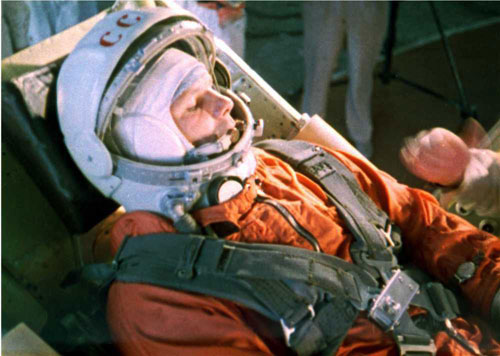
    On 12th. April 1961 the first man went into space: Yuri Gagarin orbited the earth.
    This was science-fiction come to life and it didn't matter that the hero was Russian - it was the event itself that was awesome.

    Anyway - getting to the point - I recently discovered that the type of watch that Gagarin wore into space was available on the internet and, after doing some research, I happened upon the example shown here.
    The watch-band and the dial are reproductions - modern replacements for what must have been very tired 50-year old originals - and the original perspex crystal has been replaced with a more recent (acrylic) item, but the movement, case and back-plate are exactly as issued back in the 1960's.

    It was a hand-wound Shturmanskie (often spelt without the 'h') with central seconds complication and a hacking feature that allowed the watch to be precisely stopped and synchronised with a given time signal.

    The Shturmanskie that Gagarin wore into space had a highly finished (including Geneva striping) 17 jewel, shock protected movement. The movement was housed in a chrome plated, two-piece case measuring 33 mm across, 12 mm high, with a 16 mm lug size and had a stainless steel screw back.

    A little item of nostalgia with which to commemorate the 48th. anniversary of the event and something which I will enjoy wearing occasionally.